
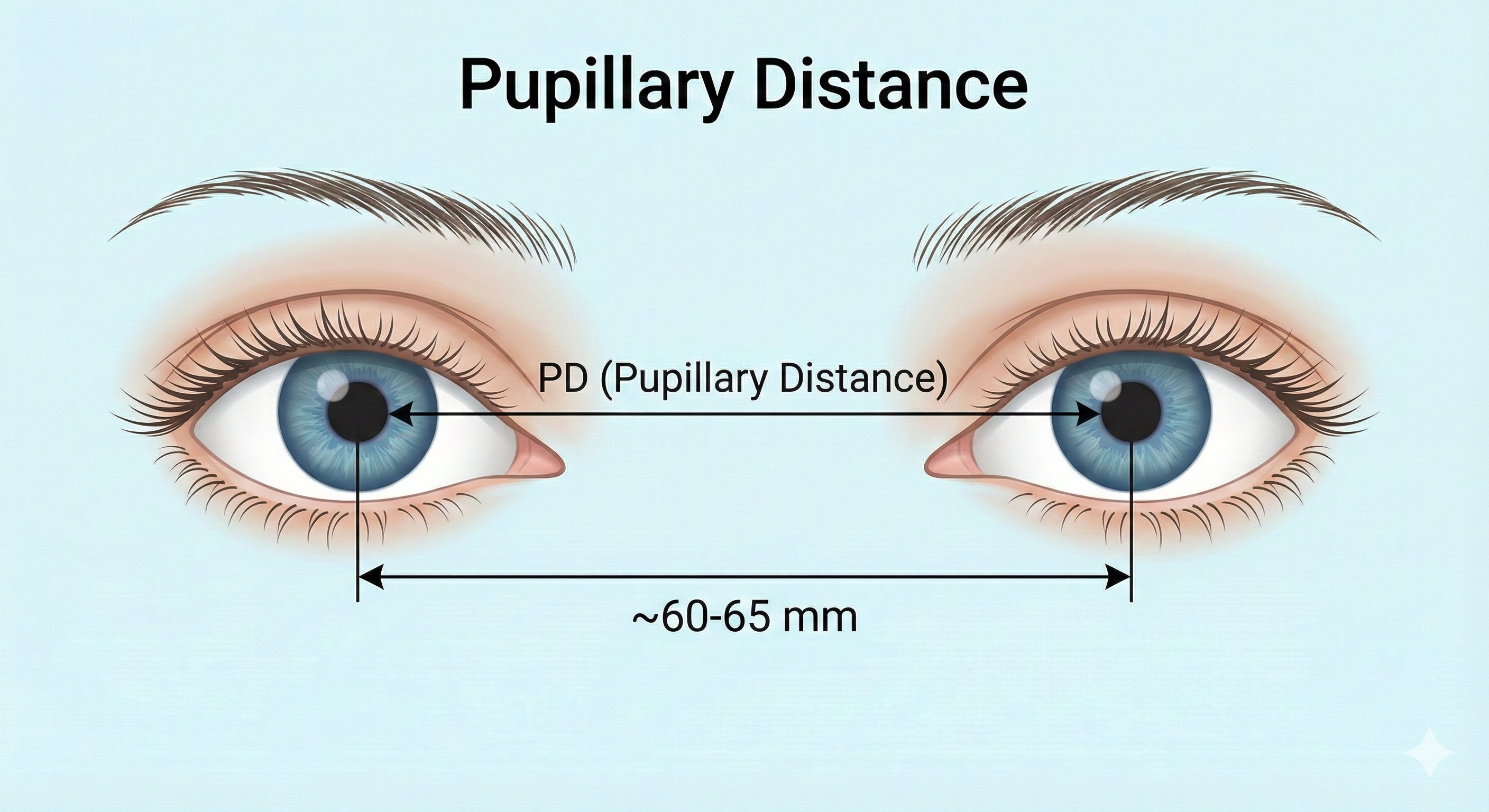
How to Measure PD (Pupillary Distance) at Home for Online Glasses
Found the perfect pair of frames on our site, but got stuck at the "PD" checkout box? You aren't alone.
One of the most common questions we get is: "How do I find my PD number?"
The good news is that you don't need a trip to the optometrist to get it. Measuring your PD is fast, free, and easy to do from your living room. This guide will show you how to measure your PD in under 3 minutes so you can order your new glasses with confidence.
What is PD and Why Does It Matter?
PD stands for Pupillary Distance. It represents the distance (in millimeters) between the center of one pupil to the center of the other.
Why is this number so important?
-
Optical Center: It tells the lens maker exactly where to position the clearest part of the lens.
-
Comfort: A correct PD ensures your eyes focus through the sweet spot of the glasses.
-
Clarity: If your PD is off, you might experience blurriness, eye strain, or headaches.

Method 1: The "Friend Assist" (Most Accurate)
The easiest and most accurate way to measure your PD is to have a friend or family member help you.
What you need: A millimeter ruler and a friend.
(Insert Image: Friend Measuring PD)
-
Positioning: Sit face-to-face with your friend, approximately an arm's length away.
-
The Ruler: Have your friend hold the ruler flat against your forehead, resting just above your eyebrows.
-
Where to Look: This is key. Look straight ahead at a distant object (like a clock on the wall) behind your friend. Do not look at your friend’s eyes, as this will cause your eyes to drift inward.
-
Measure:
-
Your friend should align the 0mm mark with the center of your right pupil.
-
Without moving the ruler, they should read the number that lines up with the center of your left pupil.
-
-
Repeat: Measure 2-3 times to ensure the number is consistent.

Method 2: The Mirror Method (DIY)
If you are by yourself, you can easily measure your own PD using a bathroom mirror.
What you need: A millimeter ruler and a well-lit mirror.
(Insert Image: Measuring in Mirror)
-
Stand Close: Stand about 8 inches (20cm) away from the mirror.
-
Align: Hold the ruler flat against your brow line.
-
Right Eye: Close your left eye. Align the 0mm mark with the center of your right pupil.
-
Left Eye: Keep the ruler completely still. Close your right eye and open your left eye.
-
Read: Read the measurement at the center of your left pupil.
-
Adjust: Since you are looking at a mirror (near distance), your eyes converge slightly. Add 3mm to your final number to get your "Far PD" (used for standard distance glasses).

Frequently Asked Questions about PD
What is the average PD for adults?
For most adults, the average PD falls between 58mm and 68mm. For children, it usually ranges between 43mm and 58mm. If your measurement is vastly different (e.g., 40mm or 80mm), you may want to measure again.
Can I use the PD from my old glasses?
Yes! Pupillary distance does not change for adults once they stop growing (usually around age 20). If you have a previous prescription card with a PD on it, you can use that number.
What is "Single PD" vs. "Dual PD"?
-
Single PD (Binocular): One number (e.g., 63). This is the total distance between pupils.
-
Dual PD (Monocular): Two numbers (e.g., 31.5/31.5). This is the distance from the center of the nose bridge to each pupil individually. This is more precise for high-prescription lenses.
Ready to Order?
Now that you have your magic number, you’re ready to shop!
[Browse Our Best-Selling Frames Here >]
Still unsure about your measurement? Simply place your order and email our support team a photo of yourself holding a standard credit card under your nose. We can digitally calculate the PD for you!

%20at%20Home%20for%20Online%20Glasses%0AFound%20the%20perfect%20pair%20of%20frames%20on%20our%20site,%20but%20got%20stuck%20at%20the%20%22PD%22%20checkout%20box?%20You%20aren't%20alone.%0AOne%20of%20the%20most%20common%20ques...)